Killer Queen: A musical deconstruction
By Hailey Cheng
Heavy metal and glam rock are what made Queen one of the most popular music groups in the seventies. Their unique ability to transform complex harmonies and arrangements into high-charting songs that span many genres allowed their music to reach communities of all shapes and sizes. This article delves into one of Queen’s many songs, Killer Queen, to gain valuable insight into the song’s texture, rhythm, and other fantastic elements that affect the way a song sounds.
Heavy metal and glam rock are what made Queen one of the most popular music groups in the seventies. Their unique ability to transform complex harmonies and arrangements into high-charting songs that span many genres allowed their music to reach communities of all shapes and sizes. This article delves into one of Queen’s many songs, Killer Queen, to gain valuable insight into the song’s texture, rhythm, and other fantastic elements that affect the way a song sounds.
Brief introduction to Killer Queen
Killer Queen was released in 1974 as the lead single from Queen’s third studio album, “Sheer Heart Attack,” and incorporated elements of pop subcultures such as power pop and pop rock.
The song is primarily about a sophisticated, high-class girl who caters to the elite clientele (upper-class clients and high-class individuals). The lyrics paint a picture of a dangerous yet captivating and gorgeous woman, likened to dynamite and laser beams, who lives a glamorous and fast-paced life. The song was written by the band’s lead vocalist and pianist, Freddie Mercury. “... It’s about a high-class girl. I'm trying to say that classy people can struggle with lust as well,” the dazzling man declared, “That's what the song is about, though I'd prefer people to put their interpretation upon it – to read into it what they like…”
Queen’s first two albums were heavily influenced by heavy metal and progressive rock music, whereas Killer Queen was a change in style. It has a laid-back, bouncy, and elegant soundscape, influenced by cabaret with a cool, swung feel. It quickly became one of the band’s most popular and enduring hits, showcasing their eclectic musical style and their theatrical and unique persona.
General structure of Killer Queen
Song structures are the organizational frameworks of a song, built using a sequence of recurring and contrasting sections, such as verses, choruses, and bridges. Killer Queen is in verse-chorus form.
In the specific song structure, the title lyrics, the most memorable music, and the main narrative are split into two sections: the verse and the chorus. By using a verse-chorus structure in Killer Queen, the song enhances the storytelling via lyrics, with verses containing detailed conversational lyrics, while the chorus delivers a harmonious and repetitive hook. For educational purposes, I have listened to Killer Queen quite a number of times in order to produce and analyse its structure briefly below. You can use this as a reference for future analytical projects related to music-y topics…
Verse 1: 0:00-0:26 Chorus: 0:26-0:53Post Chorus: 0:53-0:58Verse 2: 0:58-1:15 Pre-Chorus: 1:15-1:21Chorus: 1:21-1:33 Instrumental: 1:33-2:09 Bridge: 2:09- 2:24 Chorus: 2:24-2:45 Outro: 2:53- 3:11
Rhythm
For context, a dotted crochet is a rhythm lasting 1 and 1.5 beats, consisting of a crochet ♩(one beat), with a dot (•) added next to it, which increases the duration by half its value (+½
beats). A quaver ♪ is a musical note that lasts half a beat. One crochet is equivalent to two quavers.
The most frequent time signature throughout Killer Queen is 12/8. This is a compound time signature, so every beat is a dotted crotchet (1 and ½ beats) made up of three quavers (½ beats). There are four beats in every bar (4x2=12), so it is known as a quadruple compound time.
The time signature 12/8 produces a swinging and swirling dynamic, used to create a heavy, swaying, and soulful groove. Typically, the first eighth note of each group of three gets the primary pulse (beats 1, 2, 3, 4), with the first note of every set on emphasis while the second and third are softer, creating a "lilting" (rhythmic and somewhat cheerful) motion.
For the graphic learners, I have included images of what the rhythm may look like visually:
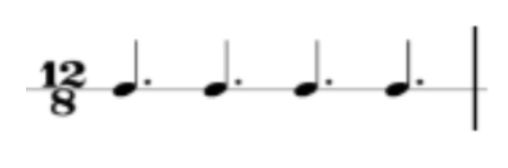
Image 1
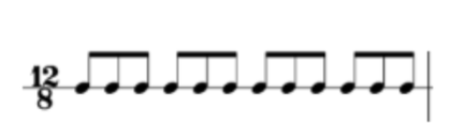
Image 2
Syncopation is a musical technique that disrupts the regular, expected rhythm of the song, emphasizing weaker beats or unexpected offbeats rather than strong beats to create a groovy and “swung feel”.
An example of syncopation is incorporated below this very sentence! The lyrics highlighted in bold are the words that are emphasized to create a bouncy groove:
She keeps a Moët & Chandon
In her pretty cabinet
Let them eat cake she says
Just like Mary Antoinette.
Melody
This section should be separated into two crucial parts: where the melody can be found, and the difference between conjunction and disjunction.
A melody is a sequence of specific musical notes arranged in a designated order of pitch and rhythm to create a recognizable and coherent tune. It could truly be considered the heart of a song, serving as the catchy tune that listeners hum and connect with. In Killer Queen, the melody can be found in the singing bits, but the guitar takes part too, in the instrumental. The voice part is almost entirely syllabic, as most pop songs are. The word syllabic refers to a vocal style where each syllable of lyrics corresponds to exactly one musical note. This is to ensure that the lyrics can be clearly understood and heard.
The song is characterized primarily by a mixture of conjunct and disjunct motions in its melody, rather than being strictly one of the other. Conjunction means that the melody moves in small steps (seconds), contributing to its tuneful, easy-to-sing, and memorable nature. Disjunction means that the song incorporates angular leaps that contrast with the smooth, stepwise motion.
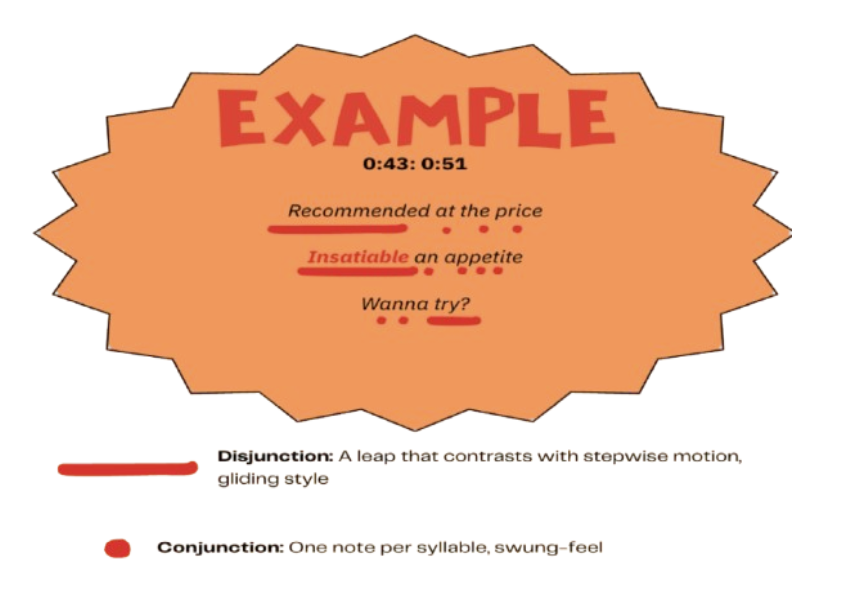
Texture and Timbre
In music, texture and timbre can be considered the two core building blocks of how a piece of music sounds and feels.
Texture refers to the layers of notes that we hear in a piece of music. It can describe the relationship between a harmony and a melody, or a combination of instruments layered together to create a feel-y piece of music.
In Killer Queen, the song’s texture is rich and multilayered, with lush harmonies and the interplay of guitar, bass, and piano creating a captivating sonic landscape. The texture is a melody-dominated homophony. There is a clear melody line, and the accompaniment mostly plays block chords on each beat. Homophony means “sounding together”. Homophonic music is played in block chords (where chords are played simultaneously to harmonize a melody).
Lastly, the element of timbre in music describes the unique quality of sound that an instrument makes. Timbre is also known as tone quality, tone color, or voice. Part of what makes up timbre is the higher-frequency harmonics an instrument makes. Queen utilises different instruments and sound effects, such as the electric guitar, piano, and keyboards. Layering the electric guitar and the keyboards together is a powerful tool that is used to create a thicker and richer sound, effectively enhancing Queen’s unique harmonic characteristics. Queen also uses vocal harmonies and feedback for additional layering. By occupying different harmonic ranges, they produce a “sound wall” that sounds both powerful and varied. This is one of Queen’s signature elements in songs, achieving an orchestral, choir-like effect by blending their distinct vocal ranges together.
Queen’s Killer Queen can be characterised by multi-layered textures and by balancing its power and elegance altogether. Originality, emotion, and energy are what set Queen apart from everyone else, portraying Queen as the embodiment of emotion and energy, and delivering it with style and class.