Musicology and environmental philosophy: How did they dream of these instruments?!
By Pia Tuominen
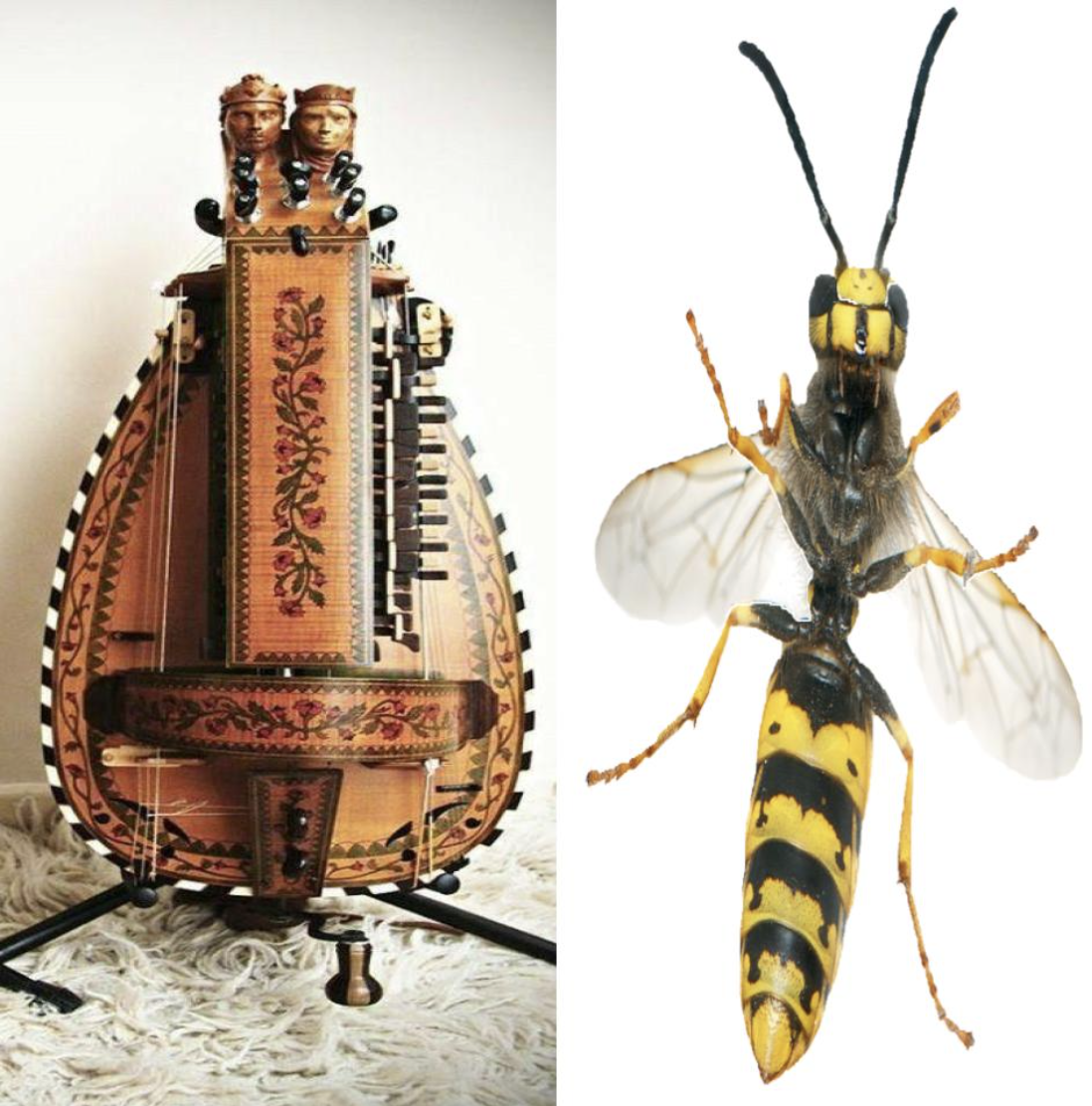
The hurdy gurdy and the bee
Many medieval drawings depict joyous musicians playing strange, distorted instruments: leaf-shaped violins, miniature church organs, string instruments akin to a wedge of camembert, and so on. To a medieval musicologist, these instruments are known as a stylized vielle, portative organ, and triangular psaltery. They are played in equally wonderful ways: for example, the portative organ is held upon one’s lap, and the bellows on the back are simultaneously moved while the keyboard is played.
Gazing at these instruments, one cannot help but wonder: How could people have dreamed up such wild, musical ideas? As I contemplated these questions, I thought: “Perhaps they took inspiration from the environment around them.” The didgeridoo came to mind; ancient Aboriginal tribes crafted eucalyptus branches from the wild, hollowed out by termites, into unique instruments. Perhaps the residents of major Medieval nations, such as the Mongol Empire, Medieval France, and the Byzantine Empire also took inspiration from the environment around them to create these instruments.
The sounds of nature are beautiful. Birds’ melodies, which spark warmth into the frigidest of hearts, are reminiscent of a piccolo’s airy tunes. Frog-shaped guiros create such froggy sounds that one could almost mistake them for the real deal. Since the wildlife around the world is so diverse, the sounds that surround you vary greatly depending on geographical location. The Ottoman Empire and the Tang dynasty are unlikely to have played similar instruments, so theories of medieval instruments’ origin can only be discerned through individual analysis. Allow me to share a few curious instruments and compare some of their wild counterparts to suggest a few possible origins.
First instrument: the shawm, which can be called the oboe’s great-grandfather. The two generations are both wind instruments that possess a reed, finger holes, and bell chamber, but the shawm is conically bored, flaring out at the bell. Compared to the oboe, it has a more solid and bright tone, suitable for serenading a loved one or calling the attention of the king’s court. The concept of a reed instrument itself is derived from nature; it is a piece of plant (typically the stem of Arundo donax or other species of reed) that vibrates musically when blown against, although it has to be meticulously crafted to produce the vibrant sound of a shawm. However, with such a vast natural world, wind blowing through hollow stems can certainly create music, too, leading to people developing instruments of a similar mechanism. When air is blown into a woodwind instrument (or a stalk of bamboo), it creates a long column of air. As the wave reflects within the instrument, it can create reverberation or sustained vibrations, allowing for a lovely noise which I’m sure medieval music-men would have loved to replicate. Humans have manipulated various factors, such as the length, holes, shape, and diameter of the tube to fashion magnificent instruments. The sheer complexity of possible sounds which can be created has arguably exceeded the natural frequencies of the wilderness.
Second instrument: the hurdy-gurdy. With this instrument, even a short tune can spark a medieval dance party. The hurdy-gurdy evolved from the organistrum, which was much larger and typically used in religious settings; it produces a harsh, grainy sound, while the hurdy-gurdy is more melodious. The hurdy-gurdy’s predecessor was created for its capabilities to sound continuous, resonant notes to accompany sacred music. Similar long drones appear in the noises that wasps and similar creatures like bees and hoverflies. The wingbeats of a wasp rapidly displace air, resulting in a buzz; their wingbeats are reported at between 117 and 247 beats per second. The hurdy-gurdy also possesses aptly named ‘drone strings’, which each sound one long, continuous note. On the other hand, it produces friction between its strings and bow to create vibrations, and a keyboard to shorten the melody string lengths to alter the frequency of the vibrations, which wasps certainly do not mimic! Despite the hurdy-gurdy’s arguably human-made and mechanical origins, the concept of its continuous drones were first generated by adorable buzzing beasts.
Third instrument: the crotalum or crotala, similar to the modern clapper or clappers. They originate from ancient Greece and Rome, but were highly popular in Medieval times, too! They produce clickety-clackity sounds, akin to the funny noises of a click beetle flipping itself over onto its legs, or the tapping of certain ant species’ mandibles, which communicate special messages with one another. These cute noises are only audible when the insects are observed conscientiously, though, so they very likely did not provide the inspiration for this instrument. A more possible origin is simply instrument designers attempting to imitate the claps of human hands. Long periods of clapping can create a stinging pain in one’s hands, but hardy crotala don’t suffer these consequences. They allow the dancing musicians who typically wielded these instruments in medieval times to keep the song’s tune throughout the entire performance or ritual.
A final addition: the gemshorn. The horn of a chamois (‘Gems’ in German) or other horned animal is taken after the animal has ascended to heaven and numerous holes are bored into it. As the horns are hollow, the pastoral people who domesticated and hunted the horned creatures probably realized they were quite suitable for instrument-making, acting like a flute once finger holes are carved. Smaller gemshorns produce a sweetly eerie and bucolic sound, while the larger variety sound much lower but retain the atmosphere of a stroll in a mysterious, windy moor.
Unfortunately, without the help of a time machine, the origins of some instruments will remain unknown till the death of the universe. Numerous ideas and experiences could have played a part in the creation and development of an instrument; a little theory composed from various websites that could be reliable may not have even brought to light a tablespoon of soil in the mountain of well-fertilized dirt that is the field of old instruments. However, if you have been searching for a limitlessly contemplative activity to do while sitting in your living room with a nice herbal cuppa, I highly recommend poring over the stories of strange musical tools.