The Odyssey (2026): Homer and Nolan’s vision
By Kavan Chan
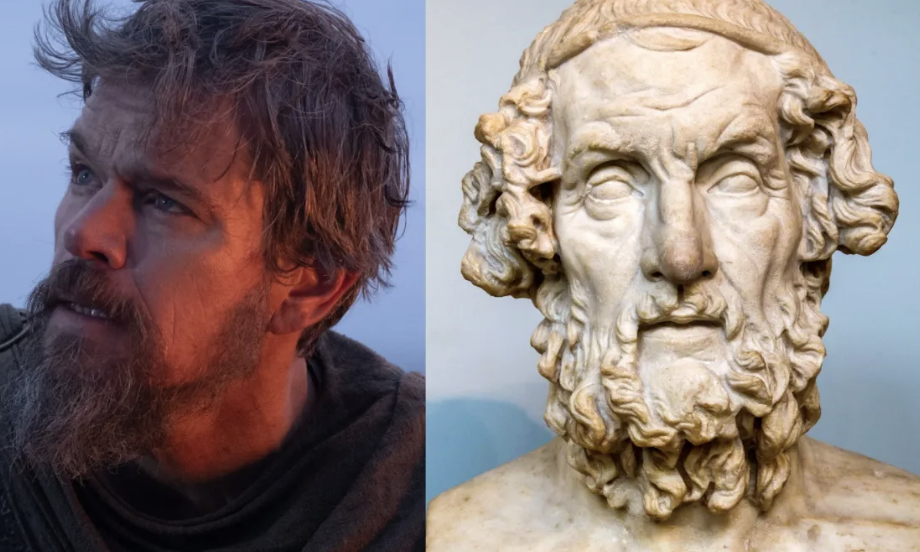
A face! A fleet! A war! A trick to break the walls of Troy! A man’s arduous journey to those he loves! The Odyssey—a nearly 3,000-year-old epic poem written, or more accurately, documented by Homer (who may or may not have actually existed)—tells the tale of Odysseus, the cunning yet fatally headstrong king of Ithaca, and his arduous journey back to his wife and son after fighting abroad in the Trojan War. Often renowned as a founding cornerstone of Western literature, The Odyssey is credited with pioneering the archetypal framework of the Hero’s Journey, a narrative structure that has guided storytelling across millennia, from Dante’s Inferno to The Lord of the Rings. Simultaneously, Homer’s Odyssey acts as a vibrant exploration of loyalty, hospitality, and divine intervention through the complex character development of its protagonist and its supporting cast, who mold Odysseus’s hubris into humility and impulsiveness into temperance (sophrosyne) through every new obstacle he faces.
In recent years, The Odyssey has resurfaced in mainstream media—and not just through the 2026 film adaptation. It was notably adapted prior by Jorge Rivera-Herrans in his episodic concept album series EPIC: The Musical, whose popularity exploded due to fan-made animatics within his online community. Another prominent reimagining is Madeline Miller’s Circe, a critically acclaimed feminist coming-of-age novel depicting the story of the witch Circe as a foe-turned-ally to Odysseus. However, this article will primarily contrast Christopher Nolan’s cinematic blockbuster with the original epic poem, highlighting the narrative and philosophical divergences between Homer’s and Nolan’s renditions.
Homer vs. Nolan
Homer’s original telling of The Odyssey explores the concept of nostos (homecoming), illustrating elements of divine intervention and fate while depicting the conflict between restraint (sophrosyne) and pride (hubris) through Odysseus’s character arc. Initially, Odysseus leaves Troy as a prideful, impulsive king with an overwhelming lust for glory and fame (kleos). Odysseus’s pride directly leads to the deaths of his men at the Cyclops’s hands when he ignores their pleas to escape, trapping them in Polyphemus’s cave. Even after their narrow escape, Odysseus unnecessarily taunts Polyphemus, abandoning his anonymity in an ego-driven pursuit of kleos by shouting his name and title. This action dooms his entire fleet by incurring the wrath of Poseidon. However, as Odysseus suffers devastating losses, he matures through every trial. He selflessly faces Circe alone to rescue his transformed crew and eventually leaves the Underworld with a sole desire for nostos, no longer caring about shallow manifestations of glory. Odysseus’s metamorphosis is fully realized upon his return to Ithaca. Disguised as a beggar, he willingly sacrifices his regal title and wealth to gain a tactical advantage, demonstrating the resilience and sophrosyne required to endure the disrespect of Penelope’s suitors in pursuit of his true home.
In contrast, Christopher Nolan interprets this mythological epic through a radically different lens, utilizing the story's cultural weight to critique warfare, deceit, morality, and human frailty. Nolan strips the original text of any explicit divine intervention. Zeus and Poseidon, who actively doom Odysseus’s crew in the epic, never physically appear in Nolan's film; instead, they exist only as natural forces—storms, waves, and psychological obstacles. Aeolus and Hermes are omitted entirely, offering no magical gifts or divine guidance. Even Athena, Odysseus’s patron goddess, exists only as a projection of Odysseus’s strategic mind and inner turmoil—eventually revealed to be a hallucination of a young priestess slain during the sack of Troy. Nolan uses this demystified divine realm to comment on human morality and how faith is often weaponized to justify atrocity. While Nolan retains the core theme of nostos—returning home transformed—he reshapes the journey into a psychological test of morality, examining how trauma and guilt alter human character.
Odysseus, played by Matt Damon, struggles with three core human vulnerabilities throughout his development: Pride, Temptation, and Lost Faith. Nolan’s interpretation carefully exposes the roots of Odysseus's arrogance. While clever, confident, and initially well-meaning, his ego is inflated by victory. Rather than heading straight home to Ithaca after Troy, Odysseus leads his exhausted crew on an extended excursion, banking recklessly on his luck. In the Cyclops episode, Odysseus uses his intellect (metis) to blind Polyphemus, but his bruised pride over losing men compels him to stubbornly shoot the Cyclops in the eye as they flee—triggering a frenzy that costs two more lives.
Odysseus’s encounter with temptation is framed through sensory and emotional addictions. Faced with the Sirens, Odysseus describes the experience: "It’s the delicious itch you go to scratch, only to find it’s under the skin where you can’t reach. What you want most is what you can least have." One crew member succumbs entirely, leaping into the sea to his death. Later, the crew’s desperation drives them to slaughter Helios’s cattle. Even his relationship with Calypso centers on temptation: she traps him for seven years using lotus flowers—a drug that erases memories while inducing artificial bliss—manipulating him out of a desperate desire for love.
Odysseus’s pride and struggle with temptation ultimately cause him to doubt the gods. In Athena’s symbolic phrasing, the gods teach humanity through life’s joys and despairs. Yet Odysseus grows cynical, believing the gods merely torment mortals for amusement. Deep down, however, Odysseus knows his cynicism stems from self-loathing. Confronted by Penelope behind a curtain, Odysseus confesses his guilt over the atrocities committed under the guise of heroic cunning. Reaching out to his hallucination of Athena—the embodiment of his conscience—Odysseus reflects on the sack of Troy:
"We violated all that was ever sacred between people. To burn the walls of Troy was to burn the world entire—including home. We lived in a world of palaces, trade, and language, blind to its beauty until we broke it. The breaking of Zeus's law spread like a plague. Maybe he couldn't bear to see the ruins of what we'd done anywhere—least of all at home."
A recurring motif in Nolan’s film is the threat of "sea people" destroying the era of trust. By violating xenia (sacred hospitality) at Troy, Odysseus became a catalyst for senseless violence. His subsequent encounters with Circe, the Cyclops, and the slaughter on Thrinacia mirror his own past transgressions. Realizing he has become no better than the suitors invading his castle, Odysseus loses faith in his right to rule. In a stark departure from the classical ending, Nolan’s Odysseus yields his throne to his son Telemachus and chooses exile, establishing that the cycle of violence can only end when its architects step away.
In conclusion, Nolan uses Homer’s Odyssey as a framework to explore morality and guilt through a modern psychological lens. By stripping away literal deities, Nolan places human agency at the center, transforming a mythic quest into a poignant study of sin, redemption, and self-awareness.
Appendix: A Concise Summary of The Odyssey
(I apologise but any decent summary of this book is gonna require a minimum of 1,500 words, I have entered a rabbit hole I couldn’t possibly escape from)
Odysseus, king of Ithaca, is contractually bound to join King Agammemnon’s crusade against Troy. Noted for his cunning, tactical mind, Odysseus devises the strategy of using the Trojan Horse, granting the Greeks victory in their decade long war. However, despite the Greek’s victory over the Trojans, Odysseus remains absent from Ithaca, his wife Penelope and infant son Telemachus for over a decade, leaving his castle vulnerable to mobs of suitors. The suitors hold the castle hostage by abusing the divine law of Xenia, feasting on his food nightly whilst conniving to usurp his throne. Guided by Athena, the goddess of wisdom, Telemachus, now an adult, abandons the “safety” of his castle, sailing to Sparta with a crew to find his missing father and reclaim authority over their family’s rightful throne.
The story’s perspective shifts to its protagonist Odysseus, who for seven years has remained trapped on the island of Calypso, an immortal nymph lovestruck by the warrior king. After being released by Calypso under Zeus’s command, Odysseus attempts to set sail on a raft back to Ithaca. But along the journey back, he is stopped by a vengeful Poseidon, who wrecks his ship and knocks him unconscious as he drifts onto the Phaecian Islands, where he regales his adventures to the Phaecian royalty under Xenia.
After sacking Troy and setting off to sea, his crew first storm and sack the island of Cicones, but under mutiny from his crew, they overstay their welcome on the island and face a deadly counterattack that forces their retreat. Afterwards, Odysseus’s crew steps onto the island of The Lotus Eaters, eating their lotus flowers, which strip the men of their memories, leaving them with a desire to stay forever on the island, forcing Odysseus to manually drag each of his drunk companions back onto the ships.
Soon after, Odysseus steps onto an island with his crew in search of food. Discovering a cave filled with flocks of sheep, Odysseus feasts on the owner’s livestock ignoring the insistence. Odysseus' pride (hubris) gets his soldiers killed, as consequently, the men are trapped inside the cave when Polyphemus, a cyclops, traps the crew inside the cave with a boulder and devours 6 of Odysseus’ men before falling asleep. Realising that killing the monster would only keep him and his men trapped, Odysseus and his crew bide their time until the second night, where Odysseus drunkens Polyphemus with offerings of wine, announcing himself as “Nobody” to retain his anonymity, ultimately leaving the cyclops in an inebriated slumber. Seeing his opening, the men gouge out the cyclops’ eye with a wooden stake, giving them the opportunity to escape when Polyphemus opens the cave for his sheep. However, compelled by his hubris and desire for fame (kleos), Odysseus boasts to the cyclops with his full name and address. This incurs the vengeance of Poseidon, God of the Seas and father of the Cyclopses, when Polyphemus prays to him for vengeance against Odysseus.
Escaping with his crew in a storm, Odysseus discovers the floating island of Aeolia, the domain of a wind god named Aeolus, who grants the desperate king a bag filled with all the storm’s winds, leaving only the western winds for his safe passage back to Ithaca. Yet despite receiving divine intervention, Odysseus keeps the contents of the bag a secret from his crew, stirring up suspicions of hidden treasure. On one fateful night, Odysseus falls asleep with the bag, and his men cut open the bag expecting riches, blowing his ships back to Aeolia, where Aeolus evicts them for being cursed by the gods.
Following days of starvation, Odysseus gets a moment of relief when his ships land on an island. Odysseus escorts his scouts with the mission of retrieving food for the crew, but his men fail in brutal fashion, attracting the attention of a clan of cannibal giants called the Laestrygonians. The giants massacre Odysseus’s already dwindling crew, annihilating 11 of his 12 ships and skewering his men with spears, forcing Odysseus to flee by sacrificing his entire fleet.
Odysseus’s growing misfortune leads him to Circe’s island, where the divine witch transforms all of his men into pigs in self defence, revealing the true nature of his men. Learning of his crew’s tragic metamorphosis, Odysseus attempts to rescue his men by confronting Circe himself. Impressed with Odysseus’s trickery and valor, the trickster god Hermes blesses Odysseus with moly, a magical herb with the capabilities to resist Circe’s witchcraft. Arriving at the sorceress's door, Odysseus is offered potions and struck with magic spells by Circe, which Odysseus was granted immunity against. Using his intelligence (metis) and Hermes’s advice, Odysseus threatens to slay the witch with his sword and brawn. Circe ultimately surrenders to Odysseus, curing his men of their afflictions and granting them temporary hospitality (xenia) , warning Odysseus of his future obstacles in Scylla and Charybdis, where Odysseus would be forced into an ethical, deadly dilemma, lose six men to Scylla or risk losing his entire ship to Charybdis (which was the inspiration behind the idiom of being between “a rock and a hard place”). Before Odysseus leaves, Circe advises him to travel into Hades to find Tiresias, a blind, dead prophet with the gift of foresight.
Travelling into the land of the dead, Odysseus encounters the spirits of his fallen comrades, Achilles and Agamemnon, who urges Odysseus to return to his kingdom disguised in secrecy (Events documented in the Oresteia). Tiresias prophesizes that Odysseus would eventually return to his homeland, but that his crew would be fated to die if they choose to slaughter Helios’s sacred cattle on Threnacia. Odysseus leaves the Underworld a changed man, his idolization of glory and kleos reformed into an entirely new purpose: survival and returning home (nostos).
Odysseus and his crew sail past the Sirens with zero casualties, powered by Circe’s advice and Odysseus’s improved leadership. Despite Odysseus’s immense growth in Hades, curiosity and intellect never leave him, illustrated by Odysseus’s orders his men to bind him to the ship’s mast whilst blocking their ears with earwax, making Odysseus the first man to survive the siren’s song.
Arriving at the domains of Scylla, a monster with six serpents for legs, and Charybdis, a living whirlpool, Odysseus withholds the truth of their existence, choosing to deceive his crew to minimise as a calculated sacrifice; Six men for the lives of his crew. As the ship encounters Charybdis, Odysseus instructs his crew to row towards the hills at top speed, and as Circe predicted, six of his remaining crew get snatched away by monstrous serpents.
Swiftly escaping the wrath of Scylla and Charybdis, Odysseus orders his crew to bypass the island of Threnacia under the warnings of Circe and Tiresias. But his words are heard by the deaf ears of his exhausted crew, feeling betrayed after suffering a constant stream of losses under Odysseus’s leadership. Eurylochus, Odysseus’s second in command, rallies the distraught crew in a mutiny against Odysseus, insisting that the crew’s exhaustion prevents them from rowing at night. Outnumbered and outcast by his crew, Odysseus yields on the condition that his crew swear oaths to leave the island’s cattle alone.
The crew receives an easy entrance into Threnacia, but storms and adverse winds prevent Odysseus’s ship from sailing, trapping his men on the island with depleted rations. One night, once Odysseus falls asleep, Eurylochus takes back the leadership of his crew and convinces his crew that they would rather die quickly at sea than suffer a slow, agonizing death to starvation. The crew slaughter then feast on Helios’s cows, immediately awakening Odysseus with the aroma of roasted cattle. Realizing that his crew betrayed their sacred oath, Odysseus prays to Zeus and the gods, knowing that his men had doomed themselves. Gradually, the winds eased up as Odysseus’s men continued to feast, and as the men left the sun god’s isle, their ship was struck with Zeus’s thunderbolt, leaving Odysseus as the sole survivor. Odysseus, half dead, floats aimlessly across the ocean, ultimately landing on Calypso’s island.
Pitying the cursed king, the Phaeacians sail Odysseus back to Ithaca. Upon landing on his homeland, Athena disguises Odysseus as a beggar, providing Odysseus with the opportunity to scout his situation without recognition. Odysseus then seeks out the hut of his old swineherd, Eumaeus, who adheres to xenia by granting him hospitality without knowing his true identity. Swayed by Athena to return to Ithaca, Telemachus avoids assassins before reuniting with his long lost father, who together formulate a plot to retake the palace.
Walking towards his old palace, Odysseus says a final farewell to his dying dog Argos then enters his castle gates begging for food. Antinous, the leader of the suitors, insults and strikes Odysseus, but he patiently conceals his rage, contrary to the prideful Odysseus on Polyphemus’s island. The disguised Odysseus is interviewed on his whereabouts by his wife, Queen Penelope, still loyal to her husband after 20 years of absence. With great restraint (sophrosyne), Odysseus confides in Penelope’s dreams to slaughter her suitors before she announces her trial for marriage with Odysseus’s old hunting bow.
The next day, Penelope conducts the “trial of the bow” on her 108 suitors, who must compete for her hand in marriage by stringing Odysseus’s old hunting bow and firing an arrow through twelve axeheads. Each of the suitors fail miserably before the next, lacking the wits or strength to even string Odysseus’s bow. Odysseus, patiently waiting upon the suitors’ struggles, steps up as a beggar for an attempt at Penelope’s trial, facing relentless mockery from the mob of suitors. Odysseus effortlessly strings the bow, plucking the string with the crackle of thunder and fires an arrow directly through all twelve axeheads. Signalling the return of Ithaca’s true king, Odysseus massacres all of the defenceless suitors with the aid of his son, Telemachus, who on the eve of the contest had concealed all of the castle’s weapons. With all the suitors dead and the castle purified of its dishonour, Odysseus is finally reunited with Penelope, living a long fruitful life with his family (Discounting the Telegony).