‘I Contain Multitudes’: Anagha Singh’s In Verse - The Journey Within
A Literary Review by Mr. D. King
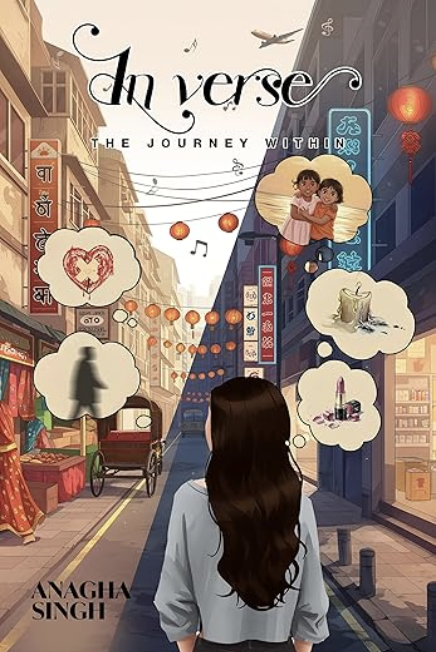
The title of this review is a reference to the 19th Century American poet Walt Whitman; an embarrassing but important allusion in the hope that this small lyrical snippet reveals the depth of my literary knowledge and critical acumen; an acknowledgement that this humble reviewer feels necessary if the reader is to take his expert opinion seriously. Because I want my review to be taken with the gravitas with which it is intended - not some fawning and warm commentary from a teacher about another successful student achievement (which it is), but a comprehensive appraisal of a poet, their themes, and the impact on the reader; something that I believe is beneficial to both the RCHK Truth readership, and the artist herself.
In Verse: The Journey Within is a foray into the life of a 15 year-old student, dealing with the conflicts and joys of an emerging adolescence, whilst facing an increasingly complex world. This brief summary may appear hyperbolic, a banal and empty platitude, but the exaggeration is warranted considering the scale of topics Miss. Singh covers throughout her 250 page collection. From the first poem - a traditional Haiku that skewers the tranquil undertones of the form to remind the reader that words can have a violent physicality - Singh moves through her internal and external reality, voicing opinions through sensory reflection, imbibing personal artifacts and trinkets with emotional weight, taking the reader on a journey through the impetuousness of youth and onwards into maturity. In Comfort Place, Singh takes us onto the vacant shores of a distant beach, as we look over her shoulder, her pencil in hand, recording sensations as the weather turns, mirroring the poet’s inner turmoil, before shockingly announcing:
How can their relationship be stronger than any other?
The ambiguity is intentional. Singh wants us to reflect, see ourselves in the fierce wind and harsh breakers, and question our own relationships. It’s completely personal, and completely universal.
And this is what makes these poems relevant. Not because they depict familiar places, but because the feelings she creates within them are so intrinsic to what it means to be human. For instance, Singh’s nostalgic turn towards her own heritage in This Feels Like Home has her reminiscing about Mumbai, her distant home, and the items that ground her within time and space. In Manchai and Gokul, Singh comments on her connection to her extended family, laughing with excitement in one, whilst lamenting loss in the other. But although these types of poems express concrete elements far removed from the average Hong Kong reader, they also feel deeply relevant and personal. They hold a mirror up to our own lack of awareness. We all have a Mumbai, or a Manchai, but through school, or business; shopping, or going out with friends, we lose sight of what is important. Which is what Miss. Singh is ultimately saying - Be Aware. After claiming that Gokul is ‘The best uncle’, and how ‘our bond is beyond that of niece and an uncle’, the reader feels content in the knowledge that they too have such relationships. Her use of the present tense lures us into this complacency, a reflection of our own grand proclamations of love, friendship, and connection. But it is the next line that reminds us that those proclamations are nothing but momentary bursts of hot air, meaningless unless attributed to something real:
Words can’t describe how much he meant.
The full stop says it all. Singh is aware of the irony - and the plight of every poet - that words simply won’t do. The best we can ever hope for is some form of approximation; something close to the truth. But unless we choose to be aware, choose to pay attention, then we may never even have the words to remind us of what we’ve lost.
I think this is what makes In Verse such a compelling collection. Singh has a way of bringing the disconnected together. Her foray into global issues in the poem Our bodies but not our choice looks at the topical issue of abortion - and Singh is not shy in voicing her opinion - but it is her tone that captures the reader. There is a frustration and anxiety that connects to the reality of the modern world. Solutions seem so obvious. Why is nothing being done? All that’s needed is for someone to ask ME - the individual voice. The poem speaks of the alienation of the individual in a world that appears beyond their control. When I asked a student the other day whether they believed they could change the world, they responded by shrugging their shoulders and questioning the possibility of how any single person could instigate change. Well, Miss Singh knows how. Alienation and helplessness only incubate on the inside. When expressed and shared with the world, they begin to crumble like the castles of sand they truly are. Because expression articulates the confusion, giving form to the formless, allowing those who feel alone to identify something they always believed to be an oddity; a recognition that we’re all just a little bit weird, and that it’s okay. In fact, it’s the weirdness that connects us. Through Singh’s expressions of vulnerability and powerlessness, she transforms our own inner isolation into a superpower.
So, the question is, do I recommend this book? Well, that depends on the journey you want to take. If you are content with your place in the world, and believe that poetry offers nothing more than a way for English teachers to punish students, then maybe Miss. Singh isn’t for you. But if you believe in opening your eyes and paying attention; taking note of what it truly means to exist, to interact with others, to try and establish connections; if you choose to seek something more than social expectation, then In Verse is your first point of access to those invisible doors. Because like Whitman’s exclamation that he ‘contains multitudes’, Singh is not just taking a journey within herself, but a journey throughout all of us.
In Verse: The Journey Within by Anagha Singh is available in paperback and digital on Amazon. Miss. Singh lives in Hong Kong and is currently in year 11 at RCHK.
Extract from In Verse: The Journey Within
On days when it's cold…
On days when it's cold, I long for a hot beam
On days when the sun hurts my eyes, I wish for rain
I'm a city girl, yet the traffic makes me want to relocate to somewhere far
Somewhere quiet
Somewhere where honks don't deafen me
Yet, being outside the city, I feel there's no melody
No music, no livelihood as I walk the empty streets
When it's morning, I wish it were night
And on dark days, I wish I could escape
On the beach, I stare up at the mountains wishing I were there
Hiking at a height and admiring the sight
But on the peak of a mountain
I wish I could parachute down because the sight of beaches was never more appealing
When I'm home, I wish I were elsewhere
But anywhere else leaves me feeling astray
So, how do I explain to you?
That isn't the same with you
That when I'm with you, I feel at ease
Feel complete
Replacements?
Alternatives?
There's no need
But how do I convince you?
That its enough for me
Without fully knowing if it's enough for you
And how do I make you believe that a girl like me could also somehow feel complete
Because, yet on days when it's cold, I long for a hot beam
Anagha Singh (2025)