From devil to comic servant: Introduction to the swaggering star of Commedia Dell’Arte
By Hailey Cheng
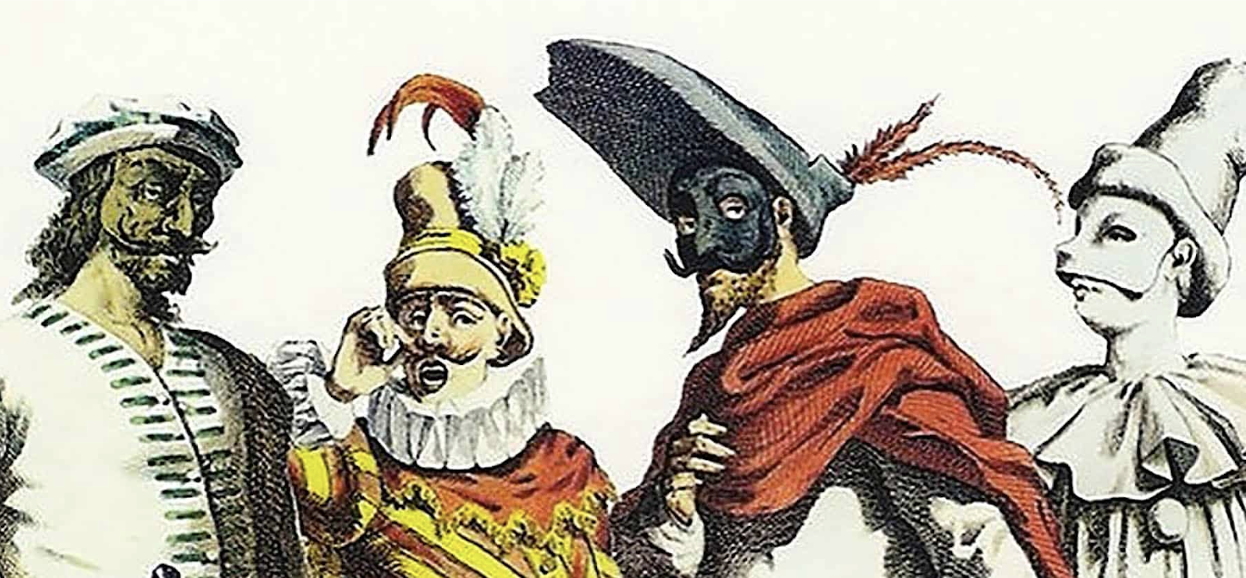
Welcome to the world of Commedia dell’Arte—the original playground of both script and improv, mischief, and whimsical character designs. Long before sketch comedy and sitcoms, masked performers spun chaos and charm into living art, turning every stumble into a story. Today, our attention will be directed towards a particular character, Harlequin, who is characterized by several traits, notably a costume featuring diamond-shaped patches.
Envision this: a swaggering servant playing a trick or two on his master, creating disorder and enjoying himself… That is the essence of what Harlequin brings to the party! The character inherits his physical agility and trickster qualities from a mischievous character in medieval Passion Plays. To trace this transition from darkness to laughter, let’s look at Harlequin’s earliest figure—The Devil himself.
The Devil Character
The mischievous and devilish attributes of the devil stock character were inherited from the medieval Harlequin (or Hellequin). The word Harlequin comes from the old French name Hellequin or Herlequin, first recorded in the 11th century by the chronicler Orderic Vitalis.
He described a spectral procession of night demons called the familia Herlequin—a troop of the damned led by a masked, club-wielding spirit. This terrifying band symbolized the Wild Hunt, a myth widespread across Europe involving ghostly riders led by a supernatural figure. The early character had nimbleness as a key attribute, preferring to swagger about, cartwheel, or somersault rather than walk. He bore a wooden sword at his waist, which he used to incite chaos, hit others, or cut open money bags. Frequently depicted as a slow-witted fool, he was also simultaneously a clever, cunning, and deceptive trickster—a true paradox, that!
Over time, his demonic manner softened into farce. By the 16th century, the strange devil-clown character transformed into the Zanni (a fancy way of saying "stock servant character") of Italian Commedia dell’arte, becoming the quick-witted and light-hearted character we now know and love today. Actors such as Tristiano Martinelli popularized the character with his diamond costume patches and half-mask, turning the once-evil, wicked character into the comic trickster he is.
The Crucial Element of Conflict
"What a lovely character Harlequin is!" one may be inclined to murmur in the wake of gaining such wonderful knowledge. However, I am aware of one individual who might vigorously disagree—a dreadful man by the name of Pantalone. In Commedia dell’arte, the relationship between Harlequin and Pantalone is a classic master-servant dynamic characterized by the crucial element of conflict.
Pantalone, the penny-pinching character of Commedia dell’arte, is the stingy, authoritarian employer of our beloved Harlequin, who constantly complains about, beats, and exploits the cheerful and cunning servant. He shuffles about in tight red trousers and a long black coat, with his nose crooked and beard pointed to exaggerate his miserly nature, significantly obsessed with his dignity, money, and status. Yet, for all his power, he is constantly outwitted and ridiculed onstage.
Opposite him, Harlequin brings chaos to Pantalone’s rigid world. As a servant, Harlequin is expected to serve and treat his master with major respect. But as a trickster, Harlequin bends every command to his own advantage, turning simple everyday tasks into pranks that expose his master’s greed and selfishness. Their scenes often erupt into slapstick, with Harlequin dodging attacks, kicks, and blows, while Pantalone stumbles and trips, ending up as the butt of the joke.
This constant clash between the playful servant and the stern master is the heart of their comedy routine. Even when Harlequin is punished, the audience knows he will bounce back—cartwheeling, scheming, and laughing—while Pantalone is left red-faced. In this way, their duet becomes theatrical fun, inviting the audience to cheer for the servant who dares to make a fool of his master.
Thematic Significance: The Mask
He’s not merely a servant character; Harlequin also serves as a complex and multi-layered figure with enduring thematic significance across the fields of literature, arts, and pop culture. His thematic depth spans from the embodiment of chaos and social commentary to a symbol of modern existential fragility. Originating as a witty, often chaotic character and hungry knave, he comes to embody social rebellion against rigid order and individuality.
One of the key themes surrounding our beloved character is his mask and ambiguity—his identity and illusion. His signature half-black mask creates a powerful, ambiguous persona that blends performance with reality. The mask serves as a shield and a mirror, representing the clear divide between “the true self” and the role one plays, highlighting the complex, dual nature of the servant—simultaneously foolish and cunning, lighthearted and sinister. It symbolizes social invisibility, allowing the character to hide his identity while acting as a witty, often subversive truth-teller and thief.
Contemporary versions recast Harlequin as a mirror for identity: as we all don bright masks to shield our trembling sensitivity—a fragile inner world vulnerable to the slightest scrutiny. This reinforces his role as a subversive truth-teller, now reflecting our own tensions between performance and reality. From a demonic wanderer to a quick-witted troublemaker of the Italian stage, Harlequin’s journey is truly one of transformation—from darkness to delight, from chaos to comedy gold. In him, we glimpse the enduring power of theatre to turn fear into laughter and masks into mirrors—reminding us that in every jest lies the truth about the human need to play, persist, and simply swagger about freely.