Making sense of idealism
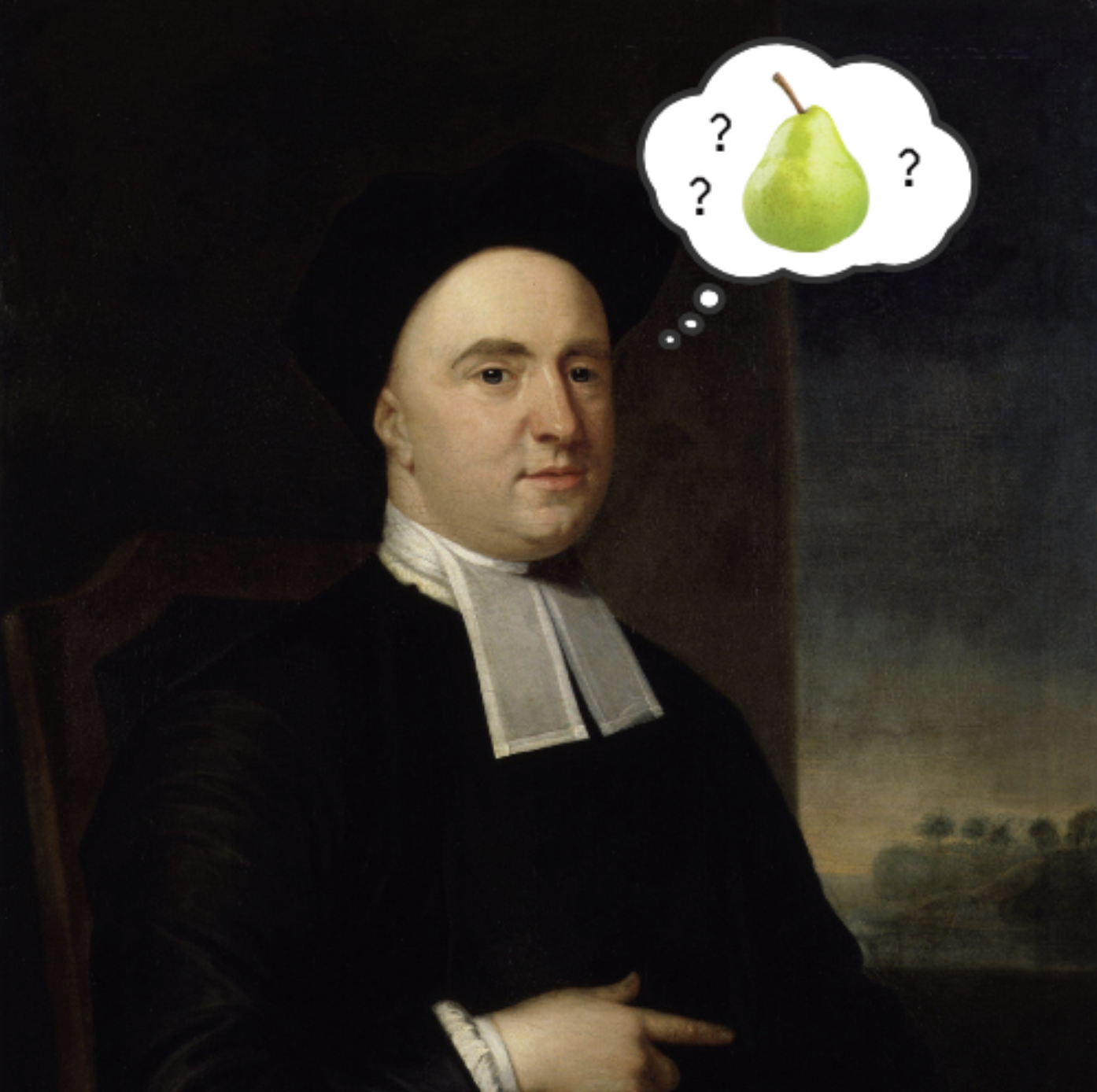
Bishop George Berkeley, the founder of immaterialism
Have you ever imagined a world where daily objects disappeared when you looked away from them, or that there was a mystical realm where perfect versions of ideas floated throughout? This is the idealist’s life. Over thousands of years, a multitude of theories have emerged concerning the matter of our reality, including skepticism, realism, and phenomenalism, but perhaps the oldest philosophy is known as idealism. Although it has fallen out of popularity, its historical significance assures its presence in modern discussions, making it an essential belief to learn about.
Idealism has boundless branches, but it is defined as the philosophy that holds reality to be dependent on the human mind. Some may use the term to describe the belief that one can achieve their goals regardless of the likelihood, as idealism, but the definitions are distinct.
It can essentially be categorized into metaphysics or epistemology.
Metaphysics deals with the basic structure of our world. Idealism states that our reality is composed of our own thoughts and rooted in our consciousness, not in matter. Metaphysical idealism can be further divided into categories: subjective idealists claim that reality lies exclusively in the mind of an individual; objective idealists think that objects transcend our perceptions, yet are still tied to our consciousness. It can be further interpreted from a microscopic scale (protons, electrons, ions, etc.), a macroscopic scale (humans and animals), or a cosmic scale (boundless higher power such as God or the universe). But ultimately, all forms of metaphysical idealism claim that the mind is primary to matter.
In epistemology, idealism attends to our knowledge of the world and how we acquire it. It connects to subjectivism, suggesting that we only know our own thoughts and sensations to be true. The sensations associated with an object, such as the warmth of the sun or the smoothness of a fresh pear, are known by philosophers as ‘sense data’, the immediate sensations that we receive before actively reasoning with an object. We can doubt that a ‘pear’ as a concept actually exists, but we cannot doubt that it is green, waxy, sweet, and tart. Idealism suggests that our wisdom is an expansive library of sense data.
To understand this philosophy, one should learn about a few key figures. Contemporary idealism began thousands of years ago: Plato’s Academy, 387 BC. Plato was an Ancient Athenian philosopher regarded as the founder of idealism, which he explored in his philosophy school. Platonic idealism revolves around the theory of ‘ideal forms’, which argues that every object is an imperfect representation of its true form, which lies beyond our consciousness, in a realm of ideas. This does not just apply to objects; concepts like love and justice also reside in this realm. Interpretations of ‘justice’ are only an emulation of its eternal and absolute truth. Plato’s theory differs slightly from each modern interpretation, but his main idea stands solid.
Unlike Plato, George Berkeley (an Irish 18th-century philosopher) didn’t believe objects existed at all. His personal philosophy is dubbed immaterialism or subjective idealism. He famously alleges, “To be is to be perceived,” claiming that objects do not exist when they are not perceived. This poses a complication, as household objects don’t fade into nothingness when we leave to run an errand, but George Berkeley was a devoted Christian. He believed that God was constantly perceiving everything, keeping the Earth stable.
Berkeley’s idealism is directly challenged by the German 18th-century philosopher Immanuel Kant’s version, transcendental idealism. Throughout his career, Kant opposed his philosophy against immaterialism, affirming that he focuses on epistemology and doesn’t endorse Berkeley. He believes our only objective wisdom is the sense data that we collect, and that our own experiences reflect how we process information. Therefore, the properties of objects from individual experiences do not belong to the objects themselves but are just our own interpretations. He suggests abstract concepts like time are also subjective, created by the mind to process the world around us, which can explain why we all perceive things differently.
After Kant, the next leading form of idealism was absolute idealism, developed into its fullest form by 19th-century German philosopher G.W.F. Hegel, associated with objective idealism. Other important names include Friedrich Schelling, who started the philosophy, and Josiah Royce, who introduced idealism to North America. Hegel was passionate about ‘dialectic thinking’, which involves analyzing contradictions and studying multiple perspectives to understand a topic deeply. It is organized into three stages: thesis (the initial idea), antithesis (contradiction of the thesis), and synthesis (a new idea combining the thesis and antithesis). His philosophy asserts that reality is created by our thoughts, guided by the world’s ‘Geist’, translated as ‘spirit’. All historical events manifest from the world Geist, and it gradually becomes more enlightened through a dialectical process. If the concept seems too abstract to comprehend, take renewable energy and fossil fuels. The thesis: humans have long relied on natural fuels as the most convenient energy source. The antithesis: renewable energy is much more beneficial for the natural environment. And so, a synthesis is produced: a society in which energy sources clash. In the future, another synthesis may be produced and further enlighten our world.
Philosophy is subjective and constantly debated, and you may find yourself agreeing or disagreeing with many idealistic notions. In Hegelian fashion, let me share its antitheses.
An idealist’s direct opposition is the materialist, who believes the basis of the world is matter.
A criticism of immaterialism is that Berkeley fails to take into account the ‘sense datum’ when he claims that an object only exists when it is being perceived. Sense data is not a perception; it is the unprocessed sensory information of an object, refuting Berkeley’s theory.
Karl Marx, a German philosopher, and his disciples strongly stood against all forms of idealism. They developed ‘dialectical materialism’, using Hegel’s dialectical thinking to comprehend material concepts instead. His main criticism was that idealism focuses far too much on thoughts and ideas, neglecting the physical world’s issues. After all, if the world around us only exists in our minds, why would we try to solve material issues such as poverty? Marx and his associate, Friedrich Engels, used this point to develop the well-known communist ideology, advocating for the equal distribution of wealth and power.
After this briefing on idealism’s history and principles, I hope you have formulated your own opinions and may even have become an idealist yourself. Exploring the world through a lens of judgment is a crucial part of being human, allowing us to make the innovations and discoveries that originally led us to become the ‘dominating species’ in the first place. Idealism is just one of the infinite beliefs, so I encourage everyone to ask thousands of questions and define their ideologies while they explore various fields of philosophy. Although it is an endless quest, the pursuit of knowledge facilitates us to achieve our fullest potential - and perhaps finally discover the true meaning of our existence…