Design of New Wetland Parks Balances Sustainability and Economic Development
By Alyssa Leong
Hong Kong has a surprising amount of ecological significance for its small size. It is situated directly on the East Asian-Australasian Flyway, one of the nine global flyways for migratory birds. The areas of the Northern New Territories contain many wetland sites of ecological importance which are recognized as habitats for migratory birds. Every year, over 50 million waterbirds migrate along the flyway, including some endangered species like the Black-faced Spoonbill. These habitats not only sustain the migratory birds, but also other conservationally important species, for example the Burmese python and Eurasian otter.
As you may know, the Hong Kong government is developing the 30,000-hectare Northern Metropolis project (NM) which covers the Northern New Territories. This is intended to create an economic boost for Hong Kong as a centre for innovation and technology. Its benefits are significant: the government website estimates that when the NM is completed, it will be home to around 2.5 million and provide around 650,000 jobs. Furthermore, it will be a major source of new land area for housing. However, the pressing problem is that this will remove 240 hectares of wetland conservation areas. Therefore, the government has come up with a solution: create new wetland parks in the Northern Metropolis. This will be known as the Wetland Conservation Parks System (WCPS).
The WCPS will consist of five new nature parks, as well as existing areas. The parks will feature diversified microhabitats which increase the area’s ecological value. The benefits of the parks are twofold: they encourage ecotourism while also compensating for the loss of habitat. The first (and largest) park recommended to be created is Sam Po Shue Nature Conservation Park. This park was designed upon the theme of “Biodiversity and Aquaculture in Harmony,” and has the intention of improving upon the current fish farming industry there by adding more advanced technology and facilities, making it more eco-friendly and productive, while simultaneously conserving and improving habitats for wildlife. It prioritizes the bird migration path as it’s situated directly on top of it.
Dr Michael Lau, Executive Director of the Hong Kong Wetlands Conservation Association, has remarked on the significance of preserving wetlands to continued sustainable development. They serve many important and beneficial environmental functions such as coastal protection, from events such as typhoons which will become more severe with climate change. Mangroves help to mitigate climate change by absorbing carbon dioxide. Wetlands can also provide social and economic benefits such as ecotourism and public engagement programmes.
However, there are still criticisms. Conservationists have argued that the Northern Metropolis development should not remove any of the fishponds as they are heavily used by endangered species. There are also worries that the proximity of the wetlands to the new city development may turn away waterbirds, as light pollution and building height affect their migration paths. Yu Yat-tung, president of the Hong Kong Birdwatching Society, noted that the situation was comparable to that in Macau. The only habitat for Black-faced Spoonbills there is the Cotai Ecological Zone, which has recently been encroached on by nearby large buildings and casinos. The number of Black-faced Spoonbills recorded in Macau has declined by 75% since 2019.
The Hong Kong government argues that there will be no net loss to the ecology of the area as the parks will increase ecological value and help preserve wetlands that may otherwise degrade. The new wetland parks will have improvements to the previous ones. For example, the government is planning to install a 35-metre no-building zone around the wetland park, and implement regulations on building height to create descending stepped buildings. These strategies will ensure a smoother transition between the wetland park and city areas and help with avoiding bird deaths caused from crashing into building windows.
Another new approach planned by the government is the introduction of more advanced, innovative technologies. Camera traps (cameras triggered by motion), bioacoustics (recording and investigation of sounds from the environment to track animal behavior), environmental DNA, AI and Internet of Things (integration of sensors and smart objects that communicate through the internet) tools can all help to monitor the ecology of wetland parks more closely and accurately than before.
Work on Sam Po Shue is scheduled to begin this year. The infrastructure company AECOM has been contracted by the government to begin planning the park, including preliminary design and landscaping works. Simon Wong, the vice president of the Land Supply/Municipal Division of AECOM, has said: “Bringing together the expertise of our ecologists, scientists, engineers and designers, along with internationally respected consultants from various disciplines, we look forward to creating a WCP that contributes to transforming Hong Kong’s New Territories North into a nature-positive Northern Metropolis.”
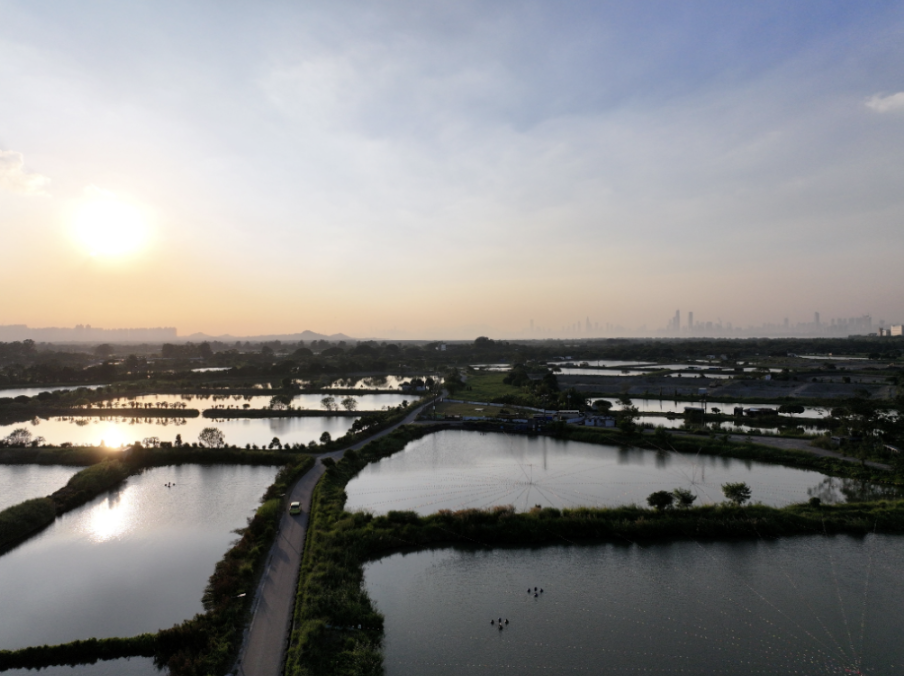
Fishponds in the Northern New Territories at the future site of Sam Po Shue. Image courtesy of AECOM.