Schrödinger’s cat is wrong!
By Pia Tuominen and Nadia Ng
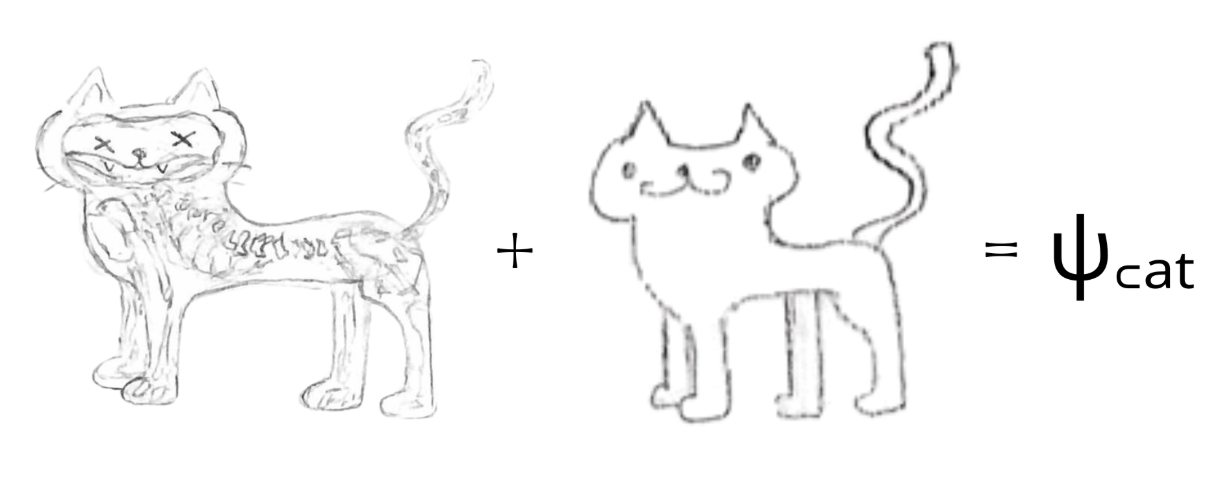
Prepare to witness one of the strangest and most confusing phenomena in quantum physics! It is called superposition–when a quantum particle simultaneously exists in two states.
Let us attempt to understand superposition with an idealistic analogy. Visualize a light ray, made up of two waves rotated in different directions. When the ray passes through a pair of 3D glasses, one of these waves is polarized, letting only one rotation of the wave pass through. When the ray is composed of two differently aligned waves, it is simultaneously in two states: for example, the ray is aligned at a bearing of 045° and 315°. The wave responds to the stimulus by ‘selecting’ one of its states, say, the bearing of 045°. The light wave makes its choice at an instant from a human point of view, and the tiny period when the wave possesses both bearings is not unlike the superposition of quantum particles.
Sounds absurd? That’s exactly what Erwin Schrödinger thought! He sought to illustrate the irrelevancy of superposition when applied to our lives, in between the macro- and microcosm with perhaps the most famous instance of superposition, involving a cat.
In this experiment, a cat is first locked in a box. The box contains a device with a radioactive particle in it: if the particle suffers decay within an hour of the cat being locked in a box, the device’s mechanism operates to shatter a flask of hydrocyanic acid, which would kill the cat with its terrifyingly toxic and volatile characteristics. If no radioactive decay occurs, the cat stays alive (probably not very happy, though). After waiting an hour, the heinous observer who locked up the cat would represent its mortality as equally alive or dead. Upon opening the box, the cat can be determined as dead or alive, so its mortality can be represented by a single state.
In Schrödinger’s cat, the cat is both alive and dead until it has been observed. However, even if the observer is not aware, the cat has already chosen a state of mortality. For example, let’s refer to the infamous ‘21 grams’ experiment. In 1907, Dr. Duncan McDougall measured changes in weight upon the death of patients, one of which lost 21 grams of mass at death. McDougall hypothesized the loss of 21 grams was the patient’s soul escaping their body, but limited evidence and too few trials discredited the hypothesis. However, this experiment does demonstrate that death exhibits concrete signs, so Schrödinger’s cat could have already been dead even if the observer cannot visually confirm its state.
Quantum particles, such as electrons and photons, exhibit both wave-like properties and particle-like properties; this concept is known as wave-particle duality. However, this cannot be applied to our daily life because we are unable to observe the wave-like behavior of particles since the solid objects around us, like strawberries or tables, are made up of an enormous amount of particles. Therefore, the nature of the wave becomes effectively invisible due to the scale of observation. It is like imagining a needle in a haystack!
In everyday life, interactions with the surrounding environment causes the particles to lose their quantum properties (superposition) and behave classically, which is why macroscopic objects do not display the properties of superposition or wave interference. This connects to superposition, because the wavelike properties of particles can only be applied in the specific scenario; that is, a particle being unobserved in a single fixed moment that cannot be exactly observed or replicated in any alternative circumstance. This is precisely because superposition describes a fleeting moment, in which the property of the quantum particle is undefined, before we are able to observe its true state. Subsequent to observation, that particle no longer exists in a state of combination (superposition), and is forced to assimilate to only one of its possible values.
This wave-like nature is the most clearly revealed in real-life experiments such as the two slits experiment. Originally performed by Thomas Young, it was designed to demonstrate light as a vibration, or wave. This was done by firing photons one by one through two narrow slits, changing the total distance travelled (path-length) and creating an interference pattern, or essentially an arrangement of dark and illuminated bands – classical particles would be expected to create two light stripes corresponding to the location of the slits.
However, when the particles are measured on which slit it goes through, the interference pattern no longer exists and the electron behaves as a classical particle. This means that the superpositions of the paths are destroyed and the electrons go through one slit or another.
To bring another layer of complexity to Schroginger’s alive / dead / undead cat analogy, we have imposed an hypothetical question: If Schrodinger's cat is true, what would happen? His analogy served to illustrate the absurdity of the Copenhagen interpretation of superposition: until an observer opens the box to reveal the cat’s fate, it is both alive and dead. His theory is quite unique in itself, that is to say, perhaps the statement on whether it is strictly ‘true’ or ‘untrue’ relies solely on the observer!
Nonetheless, If the cat really could be both dead and alive at the same time, our world would definitely feel chaotic and surreal, with macroscopic objects existing in multiple states at once, and the act of observing –rather than actual existence– would define the nature of our reality, sort of like in the Lewis Carroll’s story ‘Alice In Wonderland’, when the Cheshire cat’s grin lingers even after its body vanishes. For example: you are an amateur chef sous-viding a chicken breast. As you gaze at the pale, fleshy mass of bird pectoralis, you are aware that the entangled quantum particles that compose the breast are superposed between being just cooked enough to stay inedible and being just cooked enough to serve. As soon as you slice the chicken, the wave-like properties of the particles decompose, revealing a raw / cooked chicken.
Now all of this information is endlessly curious and fascinating, and it is so easy to fall down the rabbit hole of quantum thought. Yet as rational human beings, we might pause and wonder, why should we know all of this? Well, unless you are a quantum physicist, superposition as we know it from March 18, 2026, is virtually irrelevant to most people’s lives. Still, it can offer us a humbling reminder of how little we truly know about this world; these quantum movements took rigorous research to discover, and the world has so many more wondrous mechanisms that govern our lives in the tiniest and largest ways. Always be open-minded: who knows? Tomorrow we may discover that even our secret thoughts have hidden frequencies that penetrate through ours and our peers’ flesh to create a harmonious chorus of quantum music!