Godzilla, law, & caramel coffee: Wisdom from Dr. Griffiths
By Ella Wong
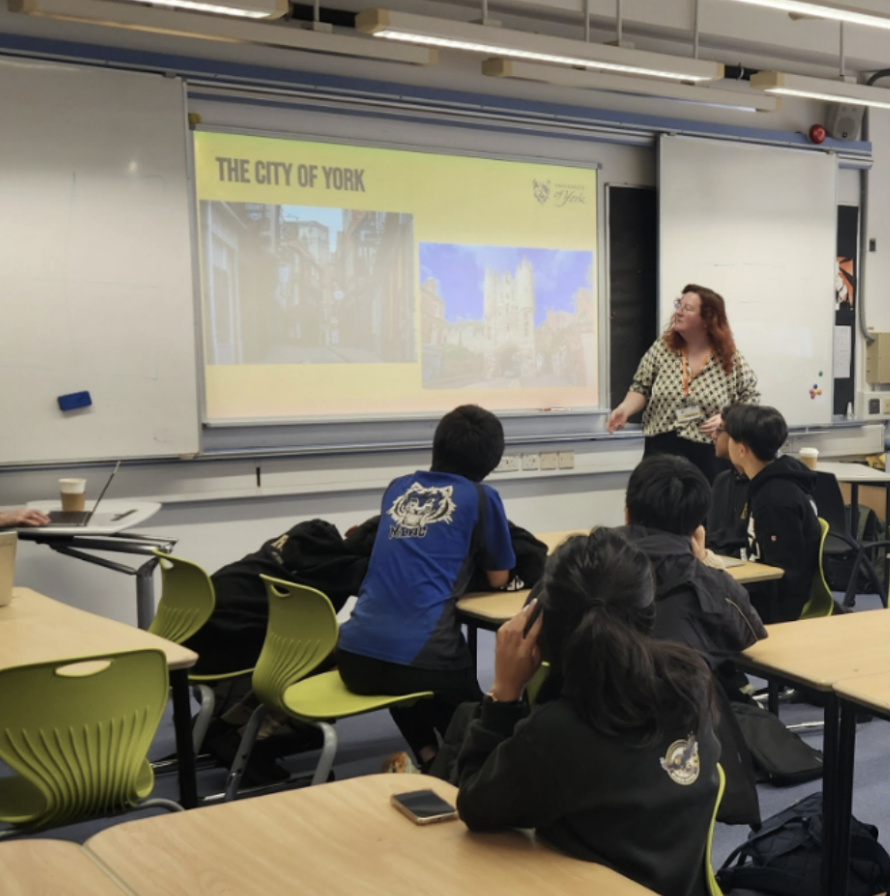
On January 27th, Dr. Rhiannon Griffiths from York Law School visited RCHK to share her experience. Specialising in international human rights law with a background in activism, Japanese history, and theatre, Dr. Griffiths gave students an overview of the University of York, and walked us through approaching a scenario solicitors might encounter in real life—guiding us to identify potential arguments, key stakeholders, and their legal interests—followed by a warm and enlightening Q&A session.
“It was an absolute pleasure [to meet students],” Dr. Griffiths said. “I only wish I could have stayed longer.”
For Bernice Cheng, Year 12 student and President of the RCHK Law Society’s fifth iteration, Dr. Griffiths’ “experience and her insights on human rights law and war crimes, which is a topic of huge speculation these days”, was particularly inspiring.
Many world leaders and governments today have been accused of human rights violations and war crimes—and yet still remain in power or in denial, raising questions amongst students about the efficacy of international law in ensuring fundamental human rights are actually upheld, and that those who breach them are held accountable. Is there a point to such law if it’s not fully implementable?
When asked her opinion on the issue, Dr. Griffiths expressed that international law in this area is rarely enforced well, but that doesn't mean it has no use. Instead, they’re ideals — benchmarks. They’re concrete, tangible and internationally recognised goals that human rights activists and organisations can use to support their arguments and to give their words weight.
International humanitarian law is a blueprint for a better world. Whether humanity builds that better world is a different matter entirely, but a skyscraper can't be constructed without a plan for it first; that’s why international law is so important, because it provides that model. The UN’s Universal Declaration of Human Rights (UDHR), though not legally binding, has served as a foundation and point of reference for state constitutions, treaties, and trade agreements that are; for example, the national constitutions of Portugal, Romania and Spain contain direct references to the UDHR.
Another key takeaway was “the education system of York Law School, with their problem-based learning,” Bernice said, “which is something that you don't see often in other law schools or universities.” Alongside traditional lectures, students at York Law School learn through case studies, discussing and researching real-life scenarios and the appropriate legal advice that could be given.
“The best thing about teaching at York is using problem-based learning in class,” Dr. Griffiths says. “I get to see very shy students turn into confident and eloquent young people who can apply the law to real-life problems. When they debate with me, that's when I know I've done my job!”
We even learned about York’s abundance of coffee shops. Dr. Griffiths’ favourite order? A caramel frappuccino she describes as “pure luxury”.
It was a fun and engaging session, and we followed up with her for further advice.
“University can be such an amazing—but challenging—experience. Studying something you're genuinely interested in makes all the difference. If it’s a subject like law, which has so many different themes and topics, finding the bit that gets you excited will ultimately make your application and your experience stand out and be more enjoyable.”
For aspiring law students in particular, she recommends the books Rule of Law by Tom Bingham and Letters to a Law Student by Nicholas J. McBride.
They’re UK-focused, but “much of it is applicable across the world too,” she says of the texts. “I think they are fabulous, and I was greatly inspired by them when I applied for a law degree.”
And to develop a deeper appreciation for the practical applications of law, Dr. Griffiths suggests critically examining popular media from different angles.
“The law is everywhere and impacts, or is impacted by, every little thing we do.
“While I was watching Godzilla Minus One, [an award-winning film that served as the focus of a research article written by Dr. Griffiths & published in the Journal of Media and Rights], it got me thinking about how law and the constitution—often seen as boring by the general public—became this underlying narrative to a thrilling blockbuster film.
“Try finding some famous or classic films and TV series that engage with the law and while watching just ask yourself occasionally...what is this saying beyond the script? The brilliant Legally Blonde for example - why is the main character portrayed as hyper-feminine? What does it add to our understanding of legal spaces?”
You might be surprised how much you find beneath the surface of your favourite films.
Regardless of whether you’re certain of a career in law, consider coming to university talks and visits from professors. Visiting experts and the FE team put time, heart and effort into them, and they’re great opportunities to peek into what the university culture or teaching is like, to ask professors about their field of expertise, explore potential passions, and learn more about your future pathways.
For example, Dr. Griffiths shared that she’d earned her Bachelor’s in Japanese and History before studying and teaching law; and from the university fair the FE team organised earlier this year, some students learned about postgraduate law conversion courses that can prepare you to pass the bar, even without a law-related Bachelor’s.
“When it comes to our future after high school,” Bernice says, “it might be possible to feel as if you can only fixate on one path and never stray from it. But after hearing the professor’s advice, I also learnt that there's no binary path you need to follow to study law or to be a lawyer, so that's also relieving.”
Thank you so much to Dr. Griffiths; Mr. Joseph Swan, on York’s East Asia Regional Management Team, who kindly lent his support for this event; and York Law School, for their time and care.