Mr King’s Delulu is not the Solulu: The Growing Trend of Fake News
By Allison Tung
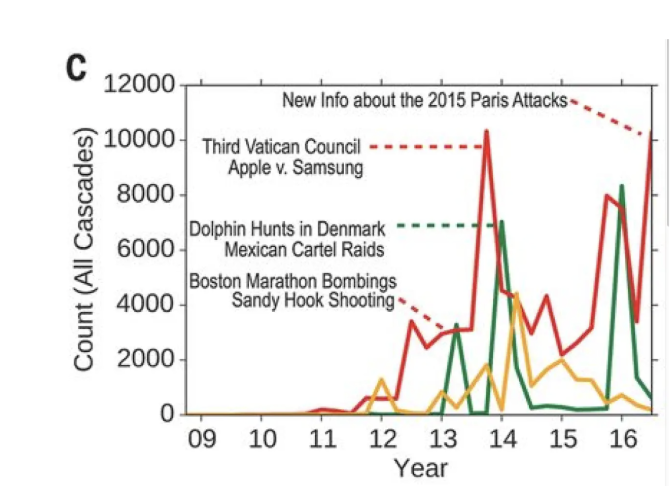
(Business Insider, Ghosh, S. (2018, March 9). MIT STUDY: Fake news spreads 6 times faster on Twitter than truth. Business Insider. https://www.businessinsider.com/mit-study-fake-news-spreads-6-times-faster-on-twitter-than-truth-2018-3)
This graph shows how fake news spreads faster and further than real news. Fake news is marked in red, true news in green, and a mix of the two in yellow. As you can see, the red lines are taller and longer, showing that there are far more information online about fake news versus true.
Mr Dane King is, technically, a teacher. This means he’s entrusted with shaping young minds, our leaders of the future, an unsettling fact once you hear him talk.
According to him, his life is reminiscent of a Karate Kid plot. He claims he studied Kung Fu under “Master Chi”, a knockoff version of Mr. Miyagi, who is known for his long, sweeping beard, and complete lack of existence. He shows off his skills in class as well, despite barely being able to do a proper Biellmann or even a kick.
Then there’s the matter of his appearance. King is convinced he bears a striking resemblance to the globally recognized actor best known as Thor in the Marvel Cinematic Universe (MCU); Chris Hemsworth. In his mind, it’s a near perfect match. He cites his facial bone structure, blue eyes and muscle tone — despite his closer resemblance to another famed character instead: Carl Fredricksen, the protagonist of the beloved childhood movie, UP. If confidence could alter bone structure, then his Chris Hemsworth pipe dream could be possible. Unfortunately, that could never happen.
His confidence doesn’t stop there. When it comes to attention from women, Mr King claims he is in surplus. In his imagination, women are lining up around the block just for him. “Ah tons! Jesus, god, it’s getting annoying.” He complains, as if he could be burdened by his own hallucinations. “Whenever I go out with my wife, I have to stop women from asking for my phone number.”
The only problem is, like Master Chi, this reality exists only in his head.
And in many ways, that’s what makes him such a fitting representative of emerging global issues as a whole.
In a contemporary world, where misinformation spreads faster than fact, and where social media, politics (I mean, that’s how Trump got the president position), and corporate culture rewards the loudest and most entertaining story instead of the most accurate one, Mr King’s delusions strike a poignant chord.
A recent study by three MIT scholars found that false news stories are 70 percent more likely to be retweeted than true stories are. It also takes true stories about six times as long to reach 1,500 people as it does for false stories to reach the same number of people. In classrooms, comment feeds, and online feeds, the same thing happens. The more attention grabbing, confident, and dramatic a story is, the faster it spreads from one person to the next, especially if no one actually checks whether the information is true.
This is the real danger. The world is slowly training people to trust the loudest voice, through social media, politics and viral content, instead of the most accurate or carefully verified one. This drowns the real news out.
A clear example of this is the Pizzagate conspiracy theory in the United States. Around 2016, an entirely fake story went viral online, which claimed a small pizza restaurant named Comet Ping Pong in Washington, D.C, was secretly linked to a child sex trafficking ring involving high profile politicians. There was no evidence, but the story spread quickly because it was dramatic and confident. On December 4, 2016, Edgar Maddison Welch, a man who believed the fake story, charged into the restaurant, armed with a rifle, revolver and a knife. Shots were fired into the floor and the walls of the restaurant. While no one was hurt, this incident left customers and employees traumatized.
Mr King’s classroom is like a mirror of how the internet and in extension, the world now works. When confidence, drama and the volume of your voice matter more than what you are actually saying, misinformation—from something as innocent as a teacher who “looks like Thor” to something much darker, like the Pizzagate conspiracy, a dramatic online story that sent a man firing shots—circulates with possibly deadly consequences. In both of the above cases, the most entertaining story wins over the truth.
If Mr King’s classroom is a preview of the future of our world, then the future depends on whether our students learn to question and verify the loudest story, or simply accept what they’re spoonfed as the truth.
To learn more:
LibGuides: Misinformation, Disinformation, and Propaganda: Resources. (2021). Cornell.Edu. https://guides.library.cornell.edu/evaluate_news/resources
Checking your browser - reCAPTCHA. (2024). Nih.Gov. https://pmc.ncbi.nlm.nih.gov/articles/PMC7250114/
ProQuest. (n.d.). How to Identify Fake News in 10 Steps. https://www.aoml.noaa.gov/general/lib/lib1/nhclib/Fake-News-WorksheetProQuest.pdf
Misinformation, Disinformation & Malinformation: A Guide - Princeton Public Library. (2026, February 13). Princeton Public Library. https://princetonlibrary.org/guides/misinformation-disinformation-malinformation-a-guide/
Ghosh, S. (2018, March 9). MIT STUDY: Fake news spreads 6 times faster on Twitter than truth. Business Insider. https://www.businessinsider.com/mit-study-fake-news-spreads-6-times-faster-on-twitter-than-truth-2018-3
(This article is not intended to be hurtful. It is merely satire and is written with Mr King’s consent. Mr King’s teaching style is unique and entertaining.)