Fatima Payman’s SKIBIDI speech, a view beyond the hype
By Atharv Misra, Anlan Xu and Anson Kam
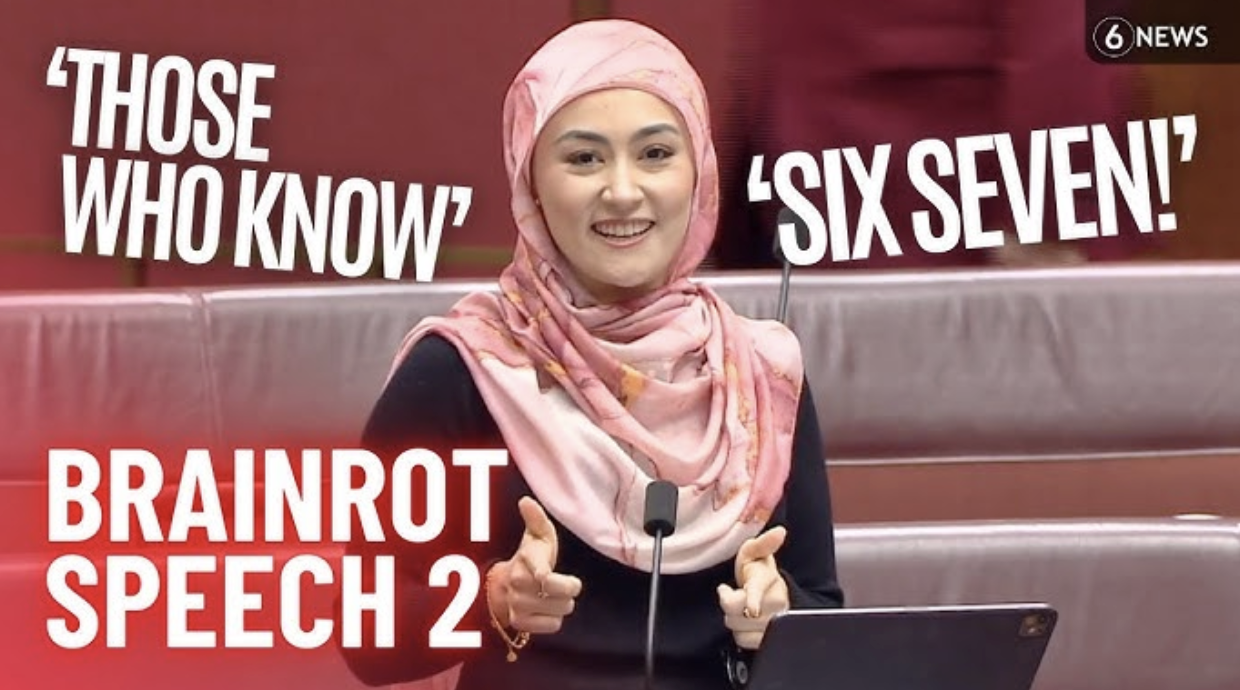
Image from Guardian Australia via YouTube
In a rapidly changing political landscape, captivating an audience of younger people (and even adults) across the media is becoming more and more challenging. Shorter attention spans are being fueled by “doomscrolling” on social media platforms—which, in itself, is a whole other issue. That said, excessive social media usage has also led to popular trends and conventions among the new generation. If used correctly, these can not only effectively convey serious issues but also retain the audience's attention. In fact, you probably clicked on this article because you saw the capital words “SKIBIDI” in the title. Yes, you’re falling for it too!
This innovative approach was carried out by an Australian Senator, specifically an Afghan-Australian woman named Fatima Payman. She used a satirical speech to address the parliament and highlight how current issues affect the younger generation. Her speech utilized terminology such as "sigmas," "goofy ahh," "capa-holics," "yap-aholics," "fanum tax," "gyatts," "taking an L," and "mog," and closed with "Skibidi." Though deemed unprofessional by the Senate—which is comprised mostly of Gen X (older politicians)—it was extremely effective in showing the true nature of politics and current issues to the younger generation through their own terminology. The result was a speech that was easy to understand for younger people, carrying a message that resonated deeply.
The actual content of her speech was also effectively chosen, specifically for the younger generations with whom this type of language resonates. She included statements about the cost-of-living crisis as well as broken tax promises (“no fanum tax”—a direct quote from her speech). This was well-spoken and highly relevant at the time, as nearly 69% of Australian households faced financial stress in 2024 from the rising costs of groceries, utilities, and healthcare.
She also addressed the housing crisis with the essential message: "All talk, no action." She attributed this to the government's overly ambitious plans, such as building 1.2 million new homes in five years to combat vacancy issues for renters (vacancy rates are currently ~1.2%, making it challenging to find a home). In reality, only ~938,000 homes were expected by 2029 (262,000 short of the target), and vacancy rates remain at ~1.2–1.3%. This resulted in her calling them “yappaholics” (full of talk) and “capping” (lying about fixes).
Overall, she tried to instill change and spread awareness about the crumbling financial and economic status of the country, which is particularly detrimental to the younger generation who have less financial backing. She also tried to oppose the proposed social media ban for under-14s, calling it “brainrot” and saying it risked kids' “Fortnite fun.” However, that law was passed and will apply to a more extreme age range of under-16s instead. This is set to be implemented on December 10, 2025, forcing sophisticated age checks on Australian media platforms, for which companies could be fined.
In summary, her speech included a call to action, empowering young people with a hopeful and positive ending. Still, she managed to effectively critique the government for its inability to ensure the issues mentioned above were addressed. She effectively spread awareness about these topics, even if one of her propositions was overridden.
Fatima’s speech was posted on platforms such as Instagram, TikTok, and YouTube Shorts. Due to its captivating nature, it reached one of the widest audiences ever for a parliamentary speech among the younger generation. By appealing to social media trends—such as the use of “brain-rotted” language paired with the uniqueness of using such informal slang in a formal setting—she spread a positive message. She hopes to instill more awareness in both the government and listeners of the speech. In conclusion, the global sensation of "brainrot" highlights the evolving landscape of attention and engagement, particularly among younger audiences!